How Do You Know When to Use Tan Sin or Cos
Sine, Cosine and Tangent
Three Functions, but same thought.
Right Triangle
Sine, Cosine and Tangent are the main functions used in Trigonometry and are based on a Right-Angled Triangle.
Before getting stuck into the functions, it helps to give a name to each side of a right triangle:
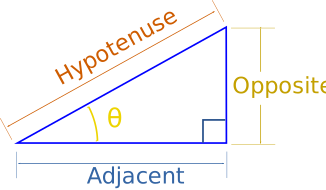
- "Opposite" is reverse to the angle θ
- "Adjacent" is adjacent (next to) to the angle θ
- "Hypotenuse" is the long one
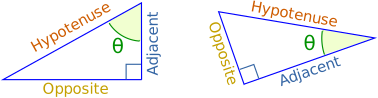
Next is e'er side by side to the angle
And Reverse is reverse the angle
Sine, Cosine and Tangent
Sine, Cosine and Tangent (ofttimes shortened to sin, cos and tan) are each a ratio of sides of a right angled triangle:
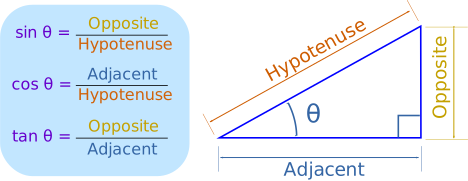
For a given bending θ each ratio stays the aforementioned
no matter how big or small the triangle is
To calculate them:
Carve up the length of one side by some other side
Example: What is the sine of 35°?
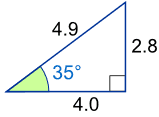
Using this triangle (lengths are only to one decimal place):
| sin(35°) | = Reverse Hypotenuse |
| = two.viii iv.9 | |
| = 0.57... | |
| cos(35°) | = Adjacent Hypotenuse |
| = four.0 4.9 | |
| = 0.82... | |
| tan(35°) | = Reverse Side by side |
| = 2.8 4.0 | |
| = 0.seventy... |
Size Does Not Matter
The triangle can be large or small and the ratio of sides stays the same.
Only the angle changes the ratio.
Endeavour dragging point "A" to alter the angle and point "B" to change the size:
Good calculators accept sin, cos and tan on them, to brand information technology easy for you. Simply put in the angle and press the button.
But yous still need to remember what they hateful!
In picture form:

Do Hither:
Sohcahtoa
How to recollect? Recall "Sohcahtoa"!
It works like this:
| Soh... | Sine = Opposite / Hypotenuse |
| ...cah... | Cosine = Adjacent / Hypotenuse |
| ...toa | Tangent = Opposite / Adjacent |
You tin can read more virtually sohcahtoa ... please recollect it, information technology may help in an test !
Angles From 0° to 360°
Move the mouse around to see how different angles (in radians or degrees) affect sine, cosine and tangent.
algebra/images/circumvolve-triangle.js
In this blitheness the hypotenuse is i, making the Unit Circle.
Notice that the side by side side and opposite side can be positive or negative, which makes the sine, cosine and tangent change betwixt positive and negative values besides.
 "Why didn't sin and tan
go to the political party?"
"... just cos!"
Examples
Case: what are the sine, cosine and tangent of 30° ?
The classic 30° triangle has a hypotenuse of length ii, an opposite side of length 1 and an side by side side of √3:
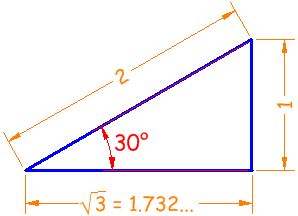
At present we know the lengths, we can calculate the functions:
| Sine | sin(thirty°) = 1 / 2 = 0.five | |
| Cosine | cos(30°) = 1.732 / two = 0.866... | |
| Tangent | tan(30°) = 1 / 1.732 = 0.577... |
(get your reckoner out and cheque them!)
Example: what are the sine, cosine and tangent of 45° ?
The archetype 45° triangle has 2 sides of 1 and a hypotenuse of √2:
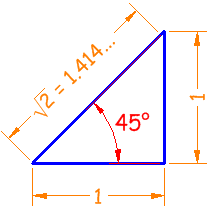
| Sine | sin(45°) = ane / i.414 = 0.707... | |
| Cosine | cos(45°) = i / i.414 = 0.707... | |
| Tangent | tan(45°) = one / i = ane |
Why?
Why are these functions important?
- Because they let us work out angles when nosotros know sides
- And they let u.s. piece of work out sides when we know angles
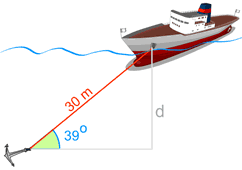
Example: Use the sine function to find "d"
We know:
- The cablevision makes a 39° angle with the seabed
- The cable has a 30 meter length.
And we want to know "d" (the distance downward).
Start with: sin 39° = reverse/hypotenuse
sin 39° = d/xxx
Swap Sides: d/thirty = sin 39°
Use a computer to find sin 39°: d/30 = 0.6293...
Multiply both sides by 30: d = 0.6293… 10 30
d = xviii.88 to ii decimal places.
The depth "d" is 18.88 grand
Practise
Try this newspaper-based exercise where you can calculate the sine function for all angles from 0° to 360°, and so graph the event. Information technology will help you to sympathize these relatively simple functions.
Yous can also see Graphs of Sine, Cosine and Tangent.
And play with a jump that makes a sine wave.
Less Common Functions
To complete the picture show, in that location are 3 other functions where we carve up one side past another, but they are not so ordinarily used.
They are equal to one divided past cos, 1 divided by sin, and one divided past tan:
| Secant Function: | sec(θ) = Hypotenuse Next | (=1/cos) | ||
| Cosecant Function: | csc(θ) = Hypotenuse Opposite | (=1/sin) | ||
| Cotangent Function: | cot(θ) = Adjacent Opposite | (=1/tan) |
1494, 1495, 724, 725, 1492, 1493, 726, 727, 2362, 2363
Source: https://www.mathsisfun.com/sine-cosine-tangent.html
0 Response to "How Do You Know When to Use Tan Sin or Cos"
Post a Comment